
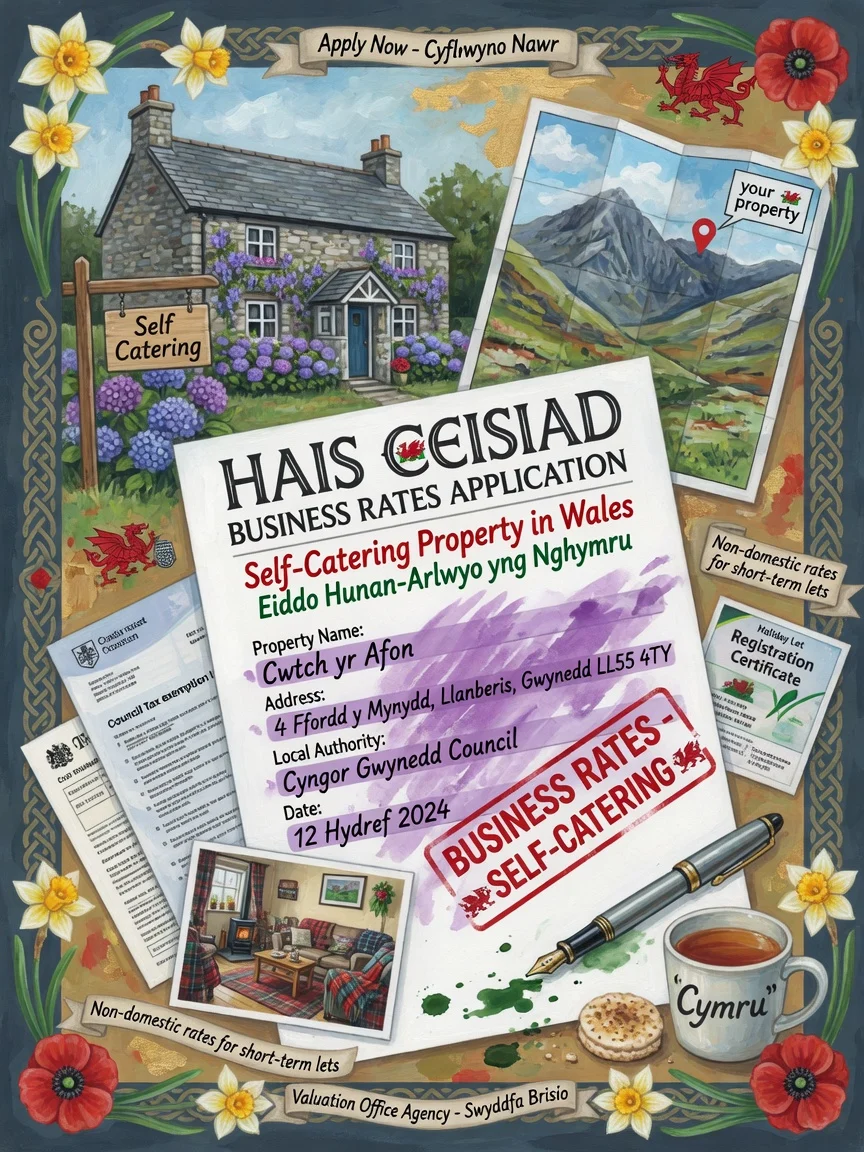
New Guidance Issued for Welsh Self-Catering Holiday Let Business Rates
Introduction
Property owners operating self-catering holiday accommodation in Wales must navigate specific criteria to qualify for business rates rather than Council Tax. Understanding these regulations is vital for accurate tax planning, ensuring compliance, and managing overhead costs effectively.
Key Details
Official guidance outlines the strict conditions property owners must satisfy to register their Welsh holiday lets for business rates through the Valuation Office Agency (VOA). To qualify, a property must meet three core requirements within a 12-month period:
- It must be available to let commercially with a profit-making intention for a minimum of 252 nights.
- It must be actually let commercially for at least 182 nights.
- The owner must intend to keep it available for commercial letting for at least 252 nights during the following 12 months.
If a property fails to achieve the 182-night threshold in a given year, owners may still meet the criteria by averaging the number of nights let across multiple properties in the same location. From 1 April 2026, owners will also be permitted to average their letting nights across the previous 24 or 36 months, provided the average reaches at least 182 nights in each 12-month period.
When calculating occupancy, owners can include commercial stays of 28 nights or less. From 1 April 2026, up to 14 nights per year where the property’s use is donated to a registered charity may also be included. However, periods spent on repairs, private use, family or discounted friend stays, and site closures cannot be counted.
Applications must be submitted using the official VOA form, which should be downloaded, completed, and emailed to selfcatering@voa.gov.uk or posted to the Valuation Officer in Durham.
What This Means for UK Businesses
For landlords, sole traders, and business owners operating tourism assets in Wales, proper property classification dictates whether you pay business rates or domestic Council Tax. Failing to meet the strict occupancy thresholds can result in properties being moved back to Council Tax, disrupting tax planning and potential small business rate relief claims. Keeping meticulous bookkeeping and occupancy records is essential to support your application and ensure ongoing compliance.
At NP & US, our expert team can support your business by streamlining your bookkeeping, managing your tax planning, and ensuring your accounting services are fully aligned with the latest regulatory changes.
Summary
Welsh self-catering holiday let owners must ensure their properties meet rigorous availability and commercial letting thresholds to qualify for business rates. With averaging rules and upcoming updates for charitable donations, maintaining accurate records is more important than ever for UK property taxpayers.
Stay informed with the latest UK tax, accounting, payroll, VAT, HMRC, Companies House and business news from NPUS.
Need Professional Advice?
If you are interested to learn more, feel free to contact us on the below to ensure you are complying today.
Telephone: 0203 4688 788
